NEO
Neo
prefix. new, recent, modified or revived
A platform that foregrounds new galleries and up-and-coming talent
Returning to Art Central for its third year, Neo creates an entry point for galleries to feature cutting-edge or undiscovered artists in their first and second years of participation. Ten galleries will be hosted under the direction of curator Enoch Cheng for a more boundary-pushing edition. Neo represents Art Central’s commitment as a leading incubator for artists and galleries in Asia’s most prominent contemporary art market.
Areté Space
Established in 2023
Beijing
Lin Ge draws from Dunhuang murals, traditional embroidery, and indigenous cultural heritage, integrating these sources with Western modernist aesthetics to construct elaborate pictorial fields where historical memory, literary narratives, and everyday experience converge. Li You’s ‘Body and Fruit’ series centres on backlit fruits and bodily forms as quiet vessels of emotion, using subtle variations of light, repetition, and focused observation to shape a calm, introspective visual space. In dialogue, the artists’ practices illuminate how narrative inheritance and sensory perception operate as parallel modes of form‑making within contemporary painting.
Image: Li You, The Skin 010, 2019. Oil on canvas, video, 48 x 59 cm. Courtesy of the artist and Areté Space.
Astra Art
Established in 2022
Shanghai
Astra Art presents four artists who challenge the notion of a singular static identity, asserting instead the self as an assemblage of lifeforms, cultural codes, and historical echoes. Jansword Zhu unveils the self’s polyphonic nature at a genetic level, transfiguring protein structures into astral bodies shaped by biological and cultural data. Eva Chen shapes softened metal and woven textile into light‑responsive structures, where fragile and permeable materialities articulate the self as an assemblage in continual reformation. Marlene Steyn constructs interconnected worlds of multiplying eyes, faces, and neural-like strands of hair through paintings and ceramics, connecting individual subjectivities to broader natural cycles. Guo Jing’s hyperrealist paintings lift everyday scenes of the self from their mundane contexts, reconfiguring them into metaphorical narratives that oscillate between charged tension and wry absurdity.
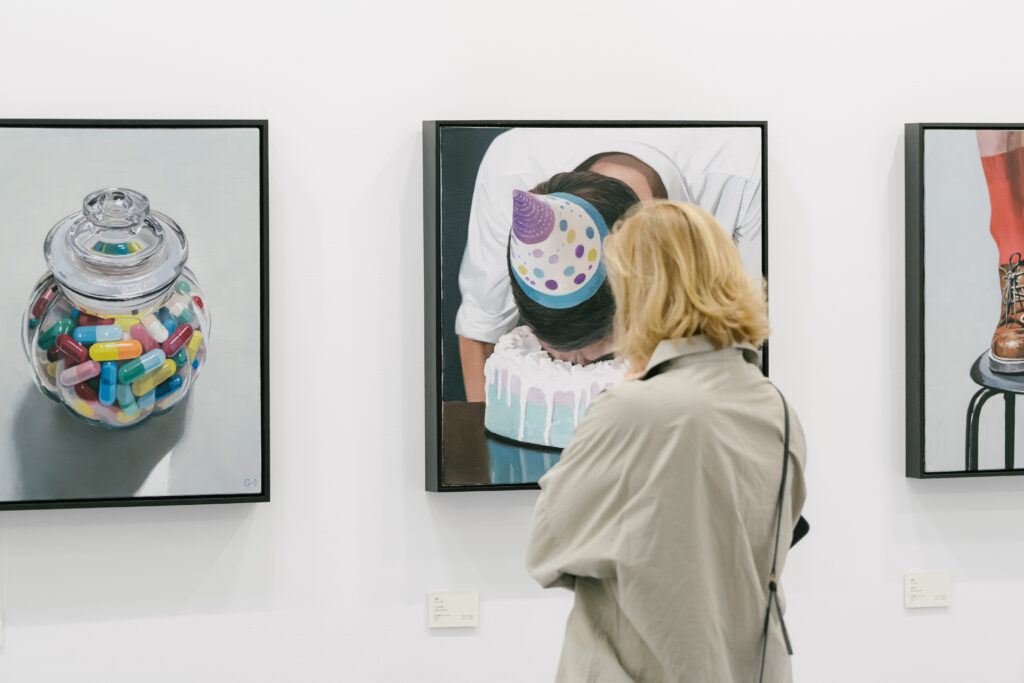
Image: Jansword Zhu, Transenlight Four Emissaries, 2024. Video Art installation, stainless steel, 1’52”, 104.8 × 72 × 60 cm. Courtesy of the artist and Astra Art
BOUNDED SPACE
Established in 2014
Beijing
BOUNDED SPACE brings together three artists working across Eastern and Western contexts who reinterpret qi (氣), traditionally understood as the vital and circulating life force that structures all phenomena, and recast it as an experiential field of perceptible and relational energies. A founding member of the underground counter-culture Chinese art collective No Name Group, Ma Kelu constructs a calligraphic order of lived energy in his ‘Ada’ series, each stroke registering a trace of physical motion and embodied presence. Jin Rilong works within a tension between turbulence and self-restraint, using blurring, reduction, and reconstruction to shape a visual field in which ambiguity and rational structure move in fluid, reciprocal relation. Maxim Zhestkov’s new media sculptures translate energetic relations into algorithmic form, envisioning dynamic systems that shift in response to the human body’s proximity and gesture.
Image: Jin Rilong, A Inky Firmament, an Ochre Earth (4), 2019. Acrylic on fabric, 300 x 300 cm. Courtesy of the artist and ©BOUNDED SPACE.
Kimreeaa Gallery
Established in 2008
Seoul
Three artists explore materiality, depth, and perception through a rigorous inquiry into how physical and visual structures shape the way we experience images in space. Casper Kang engages traditional hanji (Korean mulberry paper), dismantling and reconstituting the medium into abstract configurations that open up new material identities attuned to a contemporary sensibility. Hong Mihee’s semi-sculptural low-relief paintings, built through the accumulated layers of paperboard, create organic topographies that oscillate between image and object, their perceptual shifts activated by the viewer’s movement. Hwang Do You draws together the immediacy of Eastern brushwork and the compositional clarity of Western abstraction. By minimising narrative and emotional inflection, Hwang isolates the chromatic and tactile force of each brushstroke, forming unembellished abstract worlds charged with concentrated, elemental intensity.
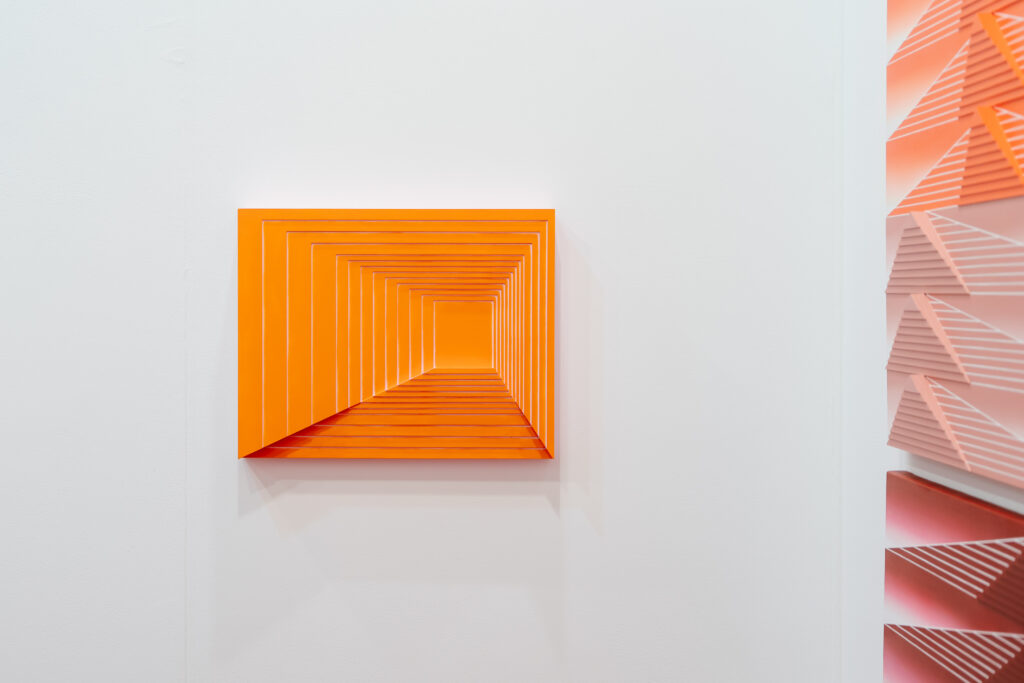
Image: Hong Mihee, Structure W2, 2025. Acrylic, paste board, canvas on panel, 27.3 x 34.8 cm. Courtesy of the artist and Kimreeaa Gallery.
Meno Parkas Gallery
Established in 1997
Kaunas
Three artists approach time not as intervals to be measured but as a rhythm to be lived, where small routines become acts of remembering that hold duration and carry it forward. Felicija Dudoit paints the engineered calm of recreational spaces such as lifeguard towers, parasols, and fountains, creating sun‑bleached images that feel subtly detached from ordinary time through their faded palette and staged stillness. Gintautas Trimakas registers duration through analogue processes such as the camera obscura; his ‘Exit’ series traces a sequence of wooden stairways over coastal dunes. Each print records a single passage, and together the images form a quiet chronometer of walking to the sea and back. Marta Frėjutė’s glass works draw on the Lithuanian childhood tradition of sekretai—secret assemblages of small treasures arranged beneath a pane of glass set into the earth. By gathering sand and assorted fragments beneath translucent surfaces, Frėjutė stages micro‑archaeologies that probe curiosity, memory, and the promise of future rediscovery.
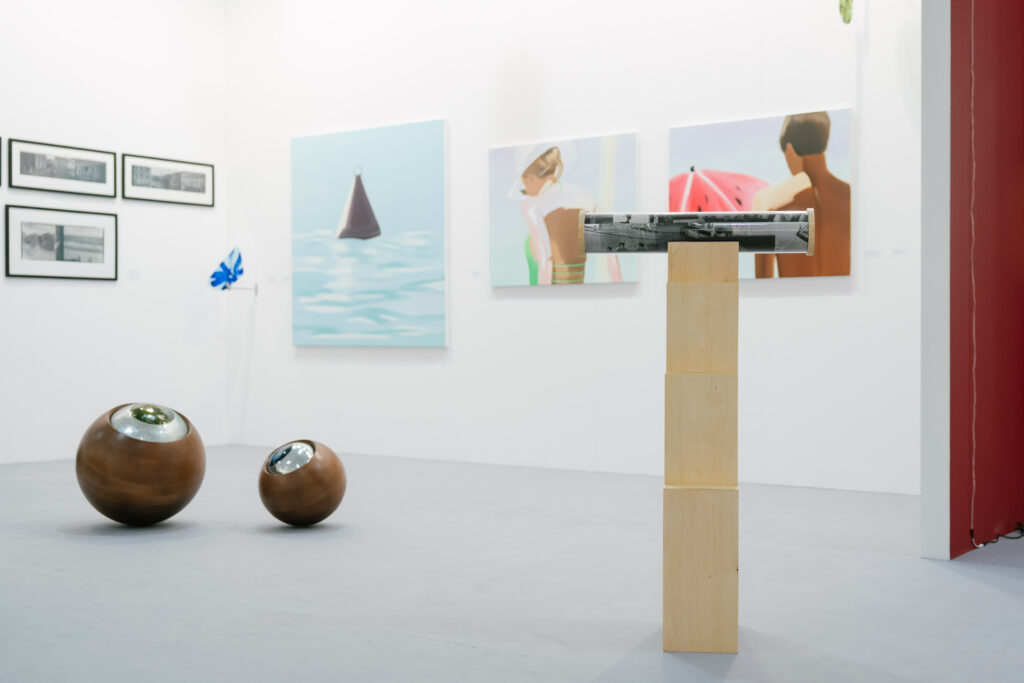
Image: Felicija Dudoit, Two Girls, 2025. Oil on canvas, 130 x 180 cm. Courtesy of the artist and Meno Parkas Gallery.
MJK Gallery
Established in 2022
Tokyo
MJK Gallery presents a dual-artist presentation grounded in the idea of art as a self-contained environment unfolding across time, space, and sensory perception. New media artist suzueri creates immersive installations. Her research‑based practice integrates layered historical narratives with self‑built instruments and sonic devices, transforming functional telecommunication technologies into poetic systems that mediate memory, perception, and connection. Nana Kuromiya’s paintings form a counterpoint grounded in organic materiality and slow accumulation. Working with oil paint modified by beeswax, pressed flowers, and other organic matter, her practice draws on mythology and literature to produce sculptural, fossil‑like surfaces that trace cycles of preservation, erosion, and renewal.
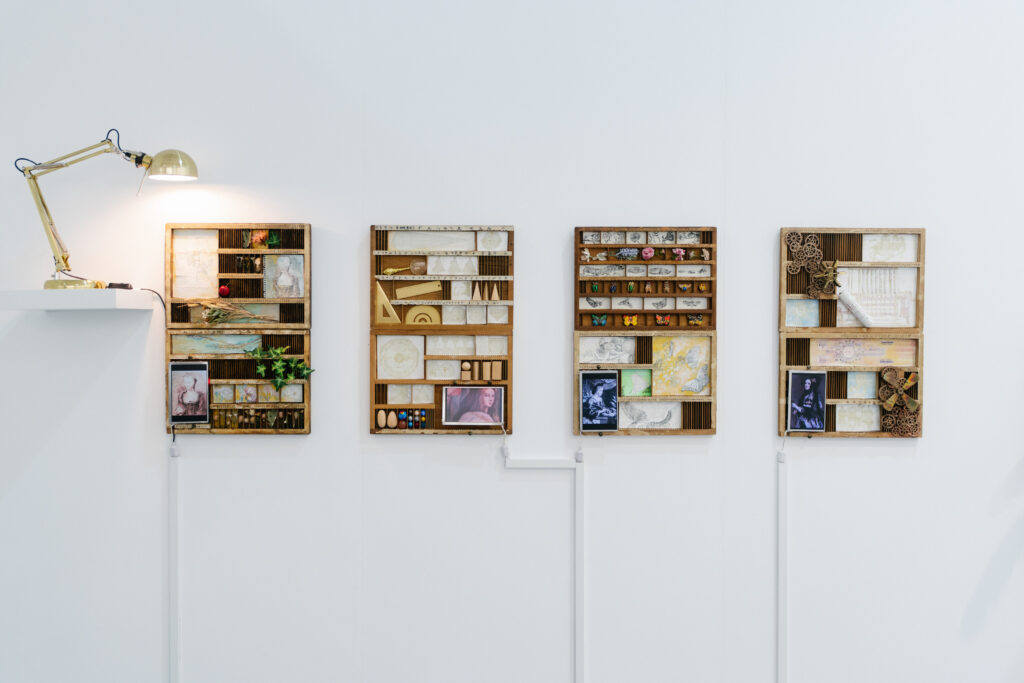
Image: Nana Kuromiya, Green hole 2, 2022. Gesso, oil, oil pastel, beeswax, reed, selaginella, involvens on wooden panel, 92 x 118 x 5 cm. Courtesy of the artist and MJK Gallery.
NoSugar Gallery
Established in 2021
Wuhan
Ming Ke’s practice examines the layered significations of the term “pine” within the Chinese cultural imagination—from the emblematic pine tree, long associated with endurance and moral uprightness, to homophonous terms embedded in everyday expressions that describe easing up or letting go. Working across oil painting, wood carving, interactive installation, and mixed media, Ke gives spatial and formal shape to these polysemic interpretations, tracing not only their natural imagery but also a vocabulary of inner sensibilities—those subtle modulations of tension and release that shape our lived experience.
Image: Ming Ke, 《松-NO.09》 , 2022. Oil on canvas, 150 x 200 cm. Courtesy of the artist and NoSugar Gallery.
The Gallery by SOIL
Established in 2012
Hong Kong
Kohei Ukai’s practice foregrounds the primitive vitality of his materials, calibrated through restraint and attentiveness. Carved from wood and patiently coated with layers of urushi lacquer (Japanese natural lacquer), Ukai’s works negotiate a balance between the material’s inherent agency and the artist’s shaping intent through a slow, accumulative process in which each layer subtly registers and responds to the form beneath it. The resulting creations, with their tactility and luminous finish, articulate a sustained commitment to nature and craft as a living practice—transforming raw matter into meditative sculptural presences.
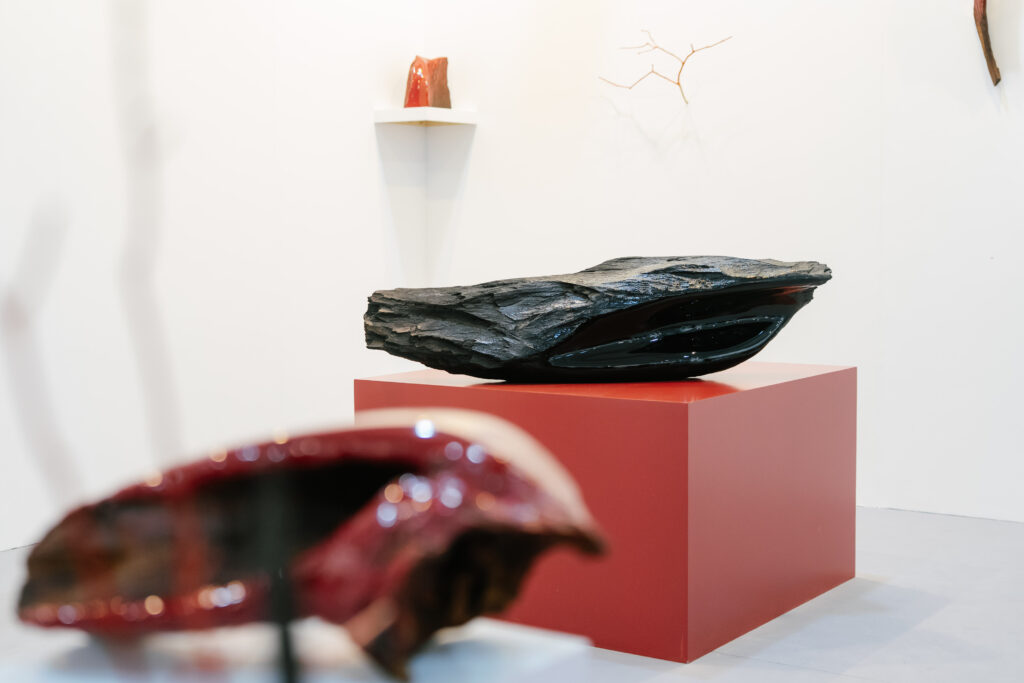
Image: Kohei Ukai, Connect II, 2025. Camphor wood, hemp, urushi lacquer, 25 × 95 × 15 cm. Courtesy of the artist and The Gallery by SOIL.
V&E Art
Established in 2018
Taipei, Paris
V&E ART presents a dialogue grounded in the colour blue between two French artists, tracing how a singular chromatic field unfolds into contrasting material worlds—one shaped by light, the other by gesture. Thomas Devaux’s sculptural photographic works are precise, self‑reflexive, and meticulously fractured, as he disassembles and recomposes consumer‑culture imagery to probe its seductive logics. His reflective dichroic glass surfaces, with their dual luminous materiality, implicate the viewer’s own image into the work, laying bare the psychological circuitry that structures contemporary desire. Nicolas Lefeuvre’s ink‑based paintings form a counterpoint informed by the discipline of Asian ink traditions and the structural sensibilities of his architectural background. Working with layers of sumi ink, gold pigments, and calligraphic interventions, Lefeuvre composes atmospheric fields that represent the density of time—memories gathered, sedimented, and held in suspension.
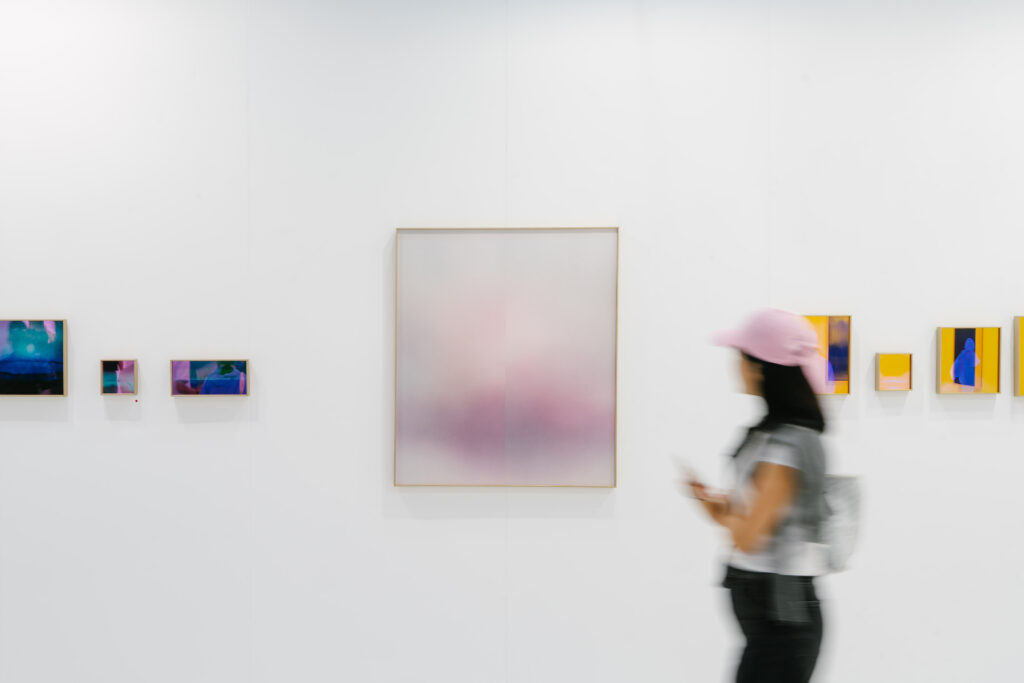
Image: Nicolas Lefeuvre, Faire de la nuit, 2025. Ink, pigments on denim, 190 x 140 cm. Courtesy of the artist and V&E ART.
Wolf & Nomad
Established in 2018
Miami
Wolf & Nomad brings together four Latin American artists whose practices draw on ancestral craft traditions, reimagining them through contemporary approaches. Alejandra Aristizabal presents large-scale, fibre-based sculptures rooted in traditional making processes, while Carla Freschi’s hand-stitched embroidery reworks historical textile techniques with modern sensibility. Christian Abusaid’s works reference ancient symbols associated with balance, well-being, and prosperity, translating them into a refined conceptual language through innovative material use. Vanessa Valerio’s tapestry works expand the boundaries of this traditional medium into unexpected forms. Across varied materials and methods, the artists share a commitment to inherited skill sets and collective memory, offering a reflection on cultural continuity within contemporary Latin American art.
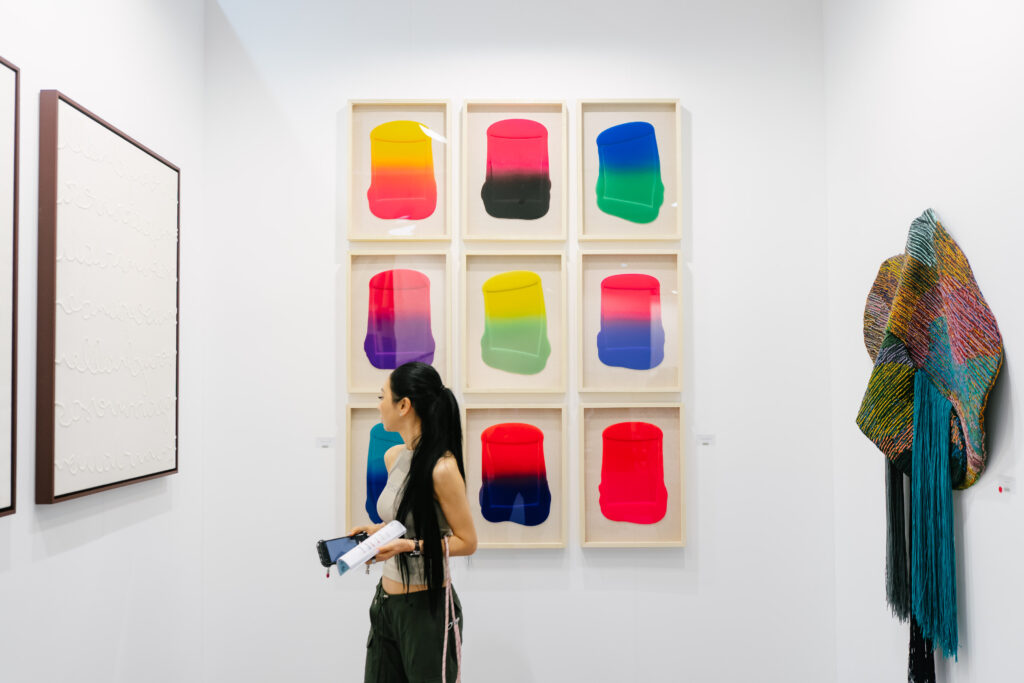
Image: Vanessa Valerio, Dissolving Time, 2025. Textile, tapestry, 110 x 90 x 15 cm. Courtesy of the artist and Wolf & Nomad
Neo
prefix. new, recent, modified or revived
Neo is a platform dedicated to galleries in their first or second year at Art Central, providing a prominent space to highlight emerging or undiscovered artists who have yet to be featured at the Fair. Neo embodies Art Central’s commitment to being a leading incubator for artists and galleries within Asia’s foremost contemporary art market.
Areté Space
Established in 2023
Beijing
Areté Space presented three artists exploring the emotional shifts of humanity in a post-truth era. Zhengyong Liu’s paintings capture inner turmoil within distorted realities, using expressive, rough brushstrokes to reflect complex psychological states in a repressive world. Guobao Chen paints intimate snapshots of travel and love, documenting fleeting moments of connection in the midst of secular life. Liu Shi’s multimedia installations merge historically charged materials with deepfake imagery, confronting the viral spread of instant emotions on social media and scrutinising generative AI’s destabilisation of historical truth.
Astra Art
Established in 2022
Shanghai
Astra Art featured three artists who examine cultural values and our contemporary perception of nature. Baoyang Chen’s reflective, animalistic sculpture incorporates new media to question our relationship with animals in the digital age of AI. Shenghao Mi’s paintings focus on nocturnal creatures, exploring the limits of human perception when behaviours in nature remain unseen. Fang Yu’s paintings invite viewers to peer into artificial landscapes through the iconic windows of Chinese gardens, prompting an interrogation of the very lens through which we observe and imagine nature.
Cub_ism_ Artspace
Established in 2020
Shanghai
Zheng Lanxiong’s installation unfolds as a dreamscape. The artist presented intimate images of fear and nostalgia in a washroom-like environment. Exquisitely rendered tempera-on-board paintings capture fleeting moments—such as the sensation of losing teeth—evoking a déjà vu familiarity that is at once distant and personal. This introspective space reflects the artist’s introverted nature and a quiet longing to be heard—an emotion deeply resonant with urban life.
FIM
Established in 2024
Seoul
Sujin Lee’s work suspends moments from daily life, like cinematic snapshots that encapsulate complex emotions, inviting contemplation on the vulnerability of human existence. Quiet yet potent, her paintings—depicting fingers typing on a keyboard, a hand holding a silver spoon against a dark background, or a car sinking into water—convey subtle yet intense anxiety. Her soft-felt sculptures, such as a campfire or a submerged car, transform unsettling psychological states into tactile, delicate forms.
Galerie Pici
Established in 2003
Seoul, New York
Shinduk Kang reinterprets still-life compositions and terracotta sculptures through expressive colours and dynamic forms. Kang’s innovative lenticular prints blend traditional motifs with vibrant hues and fluid lines, infusing plants and everyday objects with a sense of movement. These rhythmic compositions create mesmerising moments, inviting contemplation on the vitality of life, transient beauty, and cultural aesthetics.
Gallery CNK
Established in 2019
Daegu
Two artists explore emotional intensity through a feminine lens, pushing the surface of their mediums to both reveal and conceal. Sookyoung Lee’s paintings have strikingly hued lines and ambiguous shapes. The seemingly naïve interplay of abstract forms suggests the potential for interaction, yet the stillness of the flat surface hints at underlying tensions beyond the weight of colour. Inspired by childhood memories of her grandmother sewing, Jaeeun Jeon incorporates everyday materials—fabric, thread, drawers, and wooden boxes—to construct new symbols and meanings. Through her carefully composed, sensuous works, she invites viewers to explore their own nostalgia.
Intersections
Established in 2012
Singapore
Intersections Gallery presented three artists reflecting on Southeast Asia’s evolving landscapes and cultural narratives. Nge Lay layers archival images with contemporary photography, using cyanotype, blue negatives, and stamp-like visuals to explore the cyclical nature of existence while questioning how memory and history are shaped over time. Gede Sayur blends traditional Balinese religious painting techniques with elements of popular culture, offering a playful yet thoughtful take on mass tourism’s influence on Bali’s environment and heritage. Poet and artist Maung Day captures his travels through Arakanese towns with stark sketches documenting the shifting realities of Myanmar’s changing landscape.
Ivory Gate Gallery
Established in 2023
Shanghai
Ivory Gate Gallery presented a solo exhibition by Atticus Gordon, whose installation reflects an idiosyncratic world through paintings and sculptures. Rooted in early training in model-making—where exploration of creative and tactile skills such as gardening, painting, and construction was encouraged—Gordon’s sculptures take the form of miniature dioramas that blur the boundaries between art and architecture. Meanwhile, the paintings navigate the space between figuration and abstraction, often featuring bold, painterly brushstrokes and striking colour contrasts. Depicting humans within an ambiguous fusion of natural and manmade settings, these works evoke a sense of inexplicable emotion, drawing viewers into a world that resists straightforward interpretation.
Meno Parkas Gallery
Established in 1997
Kaunas
Meno Parkas Gallery presented three artists whose works reconstruct their worlds in the passage of time. Remigijus Treigys’ photographs capture empty cityscapes. Produced on toned silver gelatin print in limited edition, where its negative is destroyed after printing, the analogue photographs are textured with dust and scratches, making the transient of time. Gabrielė Aleksė’s paintings depict a fictional world where unknown architectures meet the sky and water, seemingly freezing a moment to infinity. Aistė Ambrazevičiūtė’s video installation incorporates tree barks, 3D sculptures and moving images, projecting a digital ecosystem that is self-generating and draws reference to historical plants such as lichen in a forest that grows and decays beyond a human’s sense of time.
MJK Gallery
Established in 2022
Tokyo
MJK Gallery presented two artists who engage with the fleeting sensations of experiencing the world. Satoshi Otsuka assembles cut-into-strip photographs into a single image beneath clear acrylic rulers. The resulting work offers a new perspective on nature, challenging human’s notion of nature as absolute truth. In another piece, a soft light pulses within an old clock, evoking a poetic sense of time—much like the ephemeral blue moment when the sky lingers in an afterglow before dusk. Daiki Nishimura’s works unfold through two labour-intensive stages. First, landscape photographs are altered through scraping and incense burning, with aluminium drawings incorporated to create a weathered texture. These manipulated images then serve as inspiration for Nishimura’s paintings, which depict wildfires and rain disasters driven by human impact on nature. The work compels viewers to reflect on their role in facing environmental catastrophe.
Monolog Gallery
Established in 2022
Belgrade
Monolog Gallery presented a collection of sculptural works by Ema Bregovic, where tactile textures meet geometric structures. At the heart of the installation is a reinterpretation of the famous Marilyn’s Dress—an iconic garment transformed into angular, diamond-like sculptures. These reflective pieces play with light and shadow, reinforcing the contrasts between permanence and ephemerality. By stripping away their historical allure, these objects are suspended between hardness and fragility, transcending their status as mere symbols of wealth and carrying broader cultural significance.
None Project C14 Gallery
Established in 2012
Shanghai, Tokyo
None Project C14 Gallery presented three artists who unveil hidden dimensions of nature and human experience. Yao Sun channels intense emotion through dynamic brushstrokes and enigmatic colours, crafting undulating “waves” of the cosmic unknown that evoke a deep connection between nature and the human spirit. Fu Yu embraces photography as both documentation and sketching, capturing overlooked scenes in monochrome to reveal the elusive order underlying everyday life. Weiyi Zhang employs rubbing techniques to preserve the organic textures of nature in clay, layering natural materials into intricate imprints that reflect growth and transformation over time.
Swanfall Gallery
Established in 2022
London
Three artists navigate the fluid boundaries of perception, materiality, and meaning, each reconsidering how we decode and construct reality. Miao Jialong envisions a future where organic and mechanical life converge, crafting ceramic fossils that blur the lines between nature and technology. Jiahao Qiu reinvigorates traditional ink painting with bold abstractions, using fishhooks as metaphors for desire and societal tension. Fernando M. Romero treats painting as a translational device, layering fragments of text, music, and images to explore the shifting nature of communication.
The Locker Room
Established in 2020
New York
Faustine Badrichani’s mixed media work explores the metamorphosis of the environment and the quiet endurance of womanhood. Influenced by growing up in a natural environment with a father working as a geologist in a gypsum factory, a connection to matter, transformation, and the sensitivity of the life cycle runs through the artist’s practice. A woven tapestry, inspired by a body print, translates the tactility of skin into the language of textile, while a triptych preserves the imprint of a breast before mastectomy. In a lightbox piece, medical X-rays collide with watercolour drawings—a reflection of a personal struggle with an autoimmune condition. Direct plaster-on-wire sculptures of the female form, marked by a rusted patina, pay tribute to the raw elements of an upbringing, grounding the body in the materiality of the earth. Curated by Aurore Vullierme for The Locker Room.
Yiwei Gallery
Establish in 2019
Los Angeles
Yiwei Gallery presented a duo exhibition featuring Dai Ying and Chan 13, exploring the meditative nature of time. Dai Ying’s colourful paintings on Xuan paper reflect a deep connection to natural forces and energy fields. Recurring lines and circular forms create a contemplative space for personal identity and transformation. Chan 13, drawing from his practice in horology and traditional Chinese wooden architecture, reinterprets structural principles and mechanical movements of precision instruments through paintings and installations – deconstructing cultural heritage through a contemporary lens. Merging art and design with precision engineering, timekeeping sculptures alongside paintings form a dialogue on time’s fleeting yet enduring presence.
Neo
prefix. new, recent, modified or revived
Neo is a platform dedicated to galleries in their first or second year at Art Central, providing a prominent space to highlight emerging or undiscovered artists who have yet to be featured at the Fair. Neo embodies Art Central’s commitment to being a leading incubator for artists and galleries within Asia’s foremost contemporary art market.
BFM Art Center
Established in 2021
Suzhou
British-Vietnamese performance artist KIMVI and Chinese artist Lin Wen find artistic positions through a modern world of debris. In the video “Ephemeral Post-Artefact”, KIMVI encases tiles collected from a demolished village in Suzhou with shrink wrapping printed with the image of her performance at the same site, in which she has covered herself with the green net. ‘Post-artefacts’ are also present in her photo series, produced by exposing light-sensitive paper to remnants of performances in public spaces. On the other hand, Lin Wen expresses the journey of managing fear and anxiety through paintings and mixed media. Reflecting on society’s rapid acceleration, Lin’s visual language centres on a protagonist, either seen or implied, as he seeks meaning or escape – sometimes from a ruin, other times from crowds.
KIMVI, AFTER PARTY II, 2019 (left) and PARTY TRICK II, 2019 (right), photogram, each 20.3 x 25.4 cm
Courtesy of the artist and BFM Art Center, Suzhou
biscuit gallery
Established in 2021
Tokyo
Two Japanese artists born in the 1990s convey their unease about modern society through paintings, drawings, sculptures, and videos. Although their works initially appear humorous, there are unsettling subtexts beneath them. Miyu Yamada’s signature feathery figures resembling clouds floating in dream-like landscapes are here painted using sand. The texture and unrefined style of the clouds suggest a sense of uncertainty about one’s identity. Fukumi Nakazawa’s animation explores the crisis of dehumanisation caused by technological development. Informed by her research of dance, anatomy, tools, and ergonomics, the artist’s brush and ink drawings are layered in a stop-motion manner to depict human figures transforming into artificial and otherworldly beings. Each metamorphosis, documented on stacks of illustrated Japanese paper, is eventually pasted together to form a rectangular object, a sculpture forever sealed.
Miyu Yamada, _Drive In_, 2023, Acrylic and mixed media on canvas, 116.7×91cm
Photographed by Mei Hattori. Courtesy of the artist and biscuit gallery, Tokyo
Cub_ism_ Artspace
Established in 2020
Shanghai
“Southerly Breeze” is an ambitious project that combines video poems, scriptwriting, and paintings created by the artist who goes by the pseudonym Lilyjon. For eight months, the artist captured eight thousand low-resolution pictures and audio files using his circa-2010 Nokia 2690 mobile phone while wandering around the city. From these, 127 images were selected and combined with the audio files to create a film about a chance encounter between a poet named 离离众, the alternative personality of Lilyjon, and a girl named Lu Xiaomei. The artist also painted 22 small paintings of delicate subjects, such as hair, nails, and wrinkles of the lips – all as fragments of a dream. This artistic project is a testament to the laborious and poetic journey of creating traces to construct a world.
Lilyjon, Southerly Breeze Chapter I-07: ‘When the southerly breeze comes…’, 2019, oil on canvas, 24 x 30 cm
Courtesy of the artist and Cub_ism_Artspace, Shanghai
EYECANDIES
Established in 2020
Shanghai
Eyecandies presents three female artists whose works address the roles, relationships and objectification of women in society. In Yanqi Liang’s artwork, a metaphorical intimate relationship is sewn onto fabric with printed motifs of hands and citrus fruits, depicting the complexity of the codependent relationship between humans through the threads linking hands. Weijue Wang creates striking needle-felted wool art that highlights the repression of female roles caused by social norms. Her subjects include women from adult films, domestic objects, and lingerie. Britain-based Swedish artist Frida Wannerberger’s large-scale female portraits, adorned in huge puff-sleeve dresses, fuse historical representations of women with modern garments as armour. The doll-like female figures strike irony with titles such as “You disappoint me in so many ways.”
Yanqi Liang, Bergamot 02, 2023, prints and cotton threads on canvas, 50 x 50 cm
Courtesy of the artist and Eyecandies, Shanghai
ThisWeekendRoom
Established in 2015
Seoul
Korean artist Hansaem Kim creates enchanting sculptural works that belong to the genre of contemporary fantasy. The artist presents a new series of artwork inspired by the Italian classic Dante’s Divine Comedy, in which the main character embarks on a journey through various scenes of the Inferno. The installation features religious and magic symbols in gold, stone, jewellery, and glass, as well as otherworldly statues that create a memorial-like atmosphere. By blending computer-generated images that resemble video games with objects of unique religious shapes and celestial colours, the artist transforms the classical into kitsch. Kim’s retelling of an age-old tale as mythology with imaginary aesthetics tests the validity of its significance in today’s world.
Hansaem Kim, The New Matter, 2023, acrylic paint, gold leaf, pigment print and resin, 55 x 42 x 4 cm
Courtesy of the artist and ThisWeekendRoom, Seoul
Gallery Palzo
Established in 2010
Cheongdo and Daegu
Korean artist Byeonghyeon Jeong takes an abrasive approach to painting. To begin, he covers multiple sheets of Hanji, the traditional Korean mulberry paper, with pigments, lets them dry and repeats the process until the papers are fully saturated with rich hues. Jeong then uses a tattoo needle to delicately engrave lines and dots on the paper, ripping off the surface colour from the precious Hanji layers to reveal the voluminosity of the paper and its underlying colours. The highly laborious process produces mesmerising geometrical compositions that invite the viewer to respond to the contrast between calmness and tension.
Byeonghyeon Jeong, Ambiguous Inclination 23038, 2023, pigment on Hanji on board, 30 x 30 cm
Photographed by Samju Choi. Courtesy of the artist and Gallery Palzo, Cheongdo and Daegu.
Project K
Established in 2021
Seoul
The artwork “A Totem for You and Us” by Korean artist Eojin Lee pays tribute to the marginalised labourers who make significant contributions to our society. In her childhood, she witnessed her grandmother practising shamanism in service to neighbours in the community. Taking inspiration from this memory, she uses her art to explore its power to heal the soul. In a new series, Lee addresses a tragic incident in 2022 where factory workers were killed and injured while working with machines at a bakery factory in Korea. The conspicuous absence of safety management and labour rights triggered the artist’s curiosity to scrutinise the place of dignity in the workplace, especially for factory workers. These reflections led the artist to create shamanic sculptures with delicate ceramics and found objects – symbolising the spiritual existence of each labourer – that juxtapose with conveyor belts used to deliver mass-produced goods. Lee also creates digital drawings by merging a shamanic Salpuri dance with body figures, a metaphor for the forced flexibility of low-wage workers.
Eojin Lee, Are you Okay? Vol.2 (detail), 2023, mirror, thread, found objects and metal, 80 x 100 x 40 cm
Courtesy of the artist and Project K, Seoul
PBG
Established in 2021
Seoul
In this solo presentation, Korean artist Surin Kim showcases sculptures and paintings that explore the boundaries between traditional production and digital technology. Through 3D programs, Kim finds the potential to develop forms with a novel language. Within a virtual geometric space, the artist commands computational formulas that connect lines and surface data into sculptures of unfamiliar beings. A female skeletal structure is mixed with elements of otherworldly creatures, resulting in uncanny sensuality. Kim also reinterprets the form of Korean traditional celadon ware by incorporating the element of emoji, contemplating the contemporary notion of prosperity. In a new series, the artist has merged a pagoda and its attendant worshippers into one sculpture, prompting us to question how far faith in humanity will lead us into the future.
Surin Kim, Ancient Times, 2023, UV print on canvas, 91 x 72.2 cm
Courtesy of the artist and PBG, Seoul.
wamono art
Established in 2016
Hong Kong and Tokyo
Japanese artist Wataru Yamakami‘s paintings and sculptures present a world where objects are constantly drifting mid-air. Motifs such as slime, minerals, tree twigs and trunks are painted from refuse collected by the artist on seaside walks. Walking, collecting, observing and painting became a mediating practice for his anxiety, stemming from a deep-rooted scepticism that everything in the world is fictional. Making artwork is a way for him to negotiate with anxiety as if by tapping into the subconscious realm in a surrealist painting. Thus, drifting in Yamakami’s fantastical “World of the world” series seems to be the ultimate promise where instability is the only constant.
Wataru Yamakami, World of the World – Bridge, 2020, oil on canvas, 130 × 194 × 3cm
Courtesy of the artist and wamono art, Hong Kong and Tokyo
Warin Lab Contemporary
Established in 2021
Bangkok
Thai artist Jarupatcha Achavasmit engages environmental conservation and her background in textile and design to produce alchemic sculptural works. As a child, Achavasmit learned knitting, sewing, and needlework from her grandmother, who was a seamstress and sewing teacher in the Royal Palace. Her interest in textile innovation as an artist can be seen here through the re-working of a gigantic photographic canvas left behind after an exhibition by the artist Sakarin Krue-On. Achavasmit first deconstructed the material into small strips and later wove and interlaced them with recycled yarn and fabrics made of PET plastic bottles, copper, brass, and stainless steel, ultimately transforming the landscape scene from Krue-On’s original photograph into one of abstraction. The artist applied copper powder on different parts of the photographic canvas to produce a metallic patina, creating radiant sculptural objects when hung. She has also made new tapestries by weaving the photo-canvas with other recycled materials, such as discarded bags found on the beach. Jarupatcha Achavasmit’s novel use of materials pushes the boundaries of fabric art at the intersection of environmental conservation, challenging viewers to rethink art through the lens of sustainability.
Jarupatcha Achavasmit, Colony, 2023, photographic canvas, recycled PET yarn, copper fabric, copper strips, copper powder, dimensions variable
Courtesy of the artist and Warin Lab Contemporary, Bangkok
V&E Art
Established in 2018
Taipei and Paris
“This Obscure Object of Desire” is a project by French artist Thomas Devaux, which comprises the series The Shoppers, Rayons, and Totems. In this project, the artist captures photographs of supermarket shelves and shoppers and applies algorithms to render and blur them into luminous colours. The resulting photographs are then delicately framed and positioned, much like an altar, transforming into hypnotic and contemplative icons of beauty. The abstracted images, in their reflective, glazed frames, invite the viewer to consider the artist’s proposition: “Are we living in a social fantasy of over-exquisite packaging while neglecting the essence of daily life?” Through the radiating glass, the work mirrors the dream of shopping bliss, which is, at once, both secular and sacred.
Thomas Devaux, “Shopper 8.8” (closeup), 2023, Pigmentprint,Dichroic glass, frame in alluminum with 22k gold leaf, 40x30cm
Courtesy of the artist and V&E ART, Taipei